
Pet Hunt Party RPG Monster Cards List: What They Are and What They Do
What are monster cards in Pet Hunt Party RPG? Every monster can drop its own card, and slotted cards boost ATK, HP, CRIT and more on your gear.
Quick answer
Monster cards are Pet Hunt Party RPG collectibles: every monster can drop its own card while you hunt, and once collected a card goes into a card slot on your gear, where it boosts ATK, HP, CRIT and more.
- Each monster's card is its own, so hunting a specific monster is how you chase that specific card.
- A drop shows the notification: “A monster dropped its card for you. Put it in a card slot!”
- Slotted cards boost ATK, HP, CRIT and more.
- Card information includes a Rarity field, though the exact rarity values aren't shown in the game's official listing.
What monster cards are
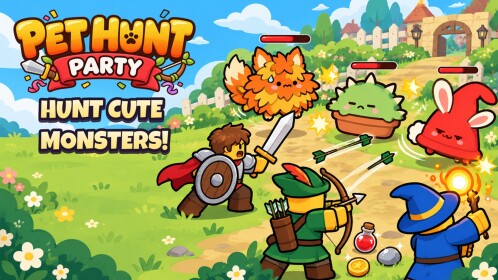
Hunting in Pet Hunt Party RPG does two jobs at once. It levels your hunter, and it builds your card collection: every monster can drop its own card, and you collect those cards as you hunt adorable pets across the floating islands.
The game's official listing doesn't name individual cards — the “list” of monster cards is effectively the monster list itself. Each monster's card is its own, so the collection is defined by the monsters in the game: if you want a particular monster's card, that monster is the one to hunt. The game's description doesn't state how often cards drop, so treat a card as a possible bonus from a hunt rather than a guaranteed pickup on every kill.
How you know a card dropped
The game announces card drops directly. When a monster drops its card, you see the notification: “A monster dropped its card for you. Put it in a card slot!” That message is your confirmation that a kill also added a card to your collection, which matters when you're grinding kills quickly with AUTO HUNT instead of watching every fight.
Card information also shows a Rarity field. The exact rarity values aren't shown in the game's official listing, so you'll be comparing cards in game rather than reading the values from that listing.
What monster cards do once collected
A card's value comes out when you equip it. You place collected cards into card slots on your gear, and slotted cards boost ATK, HP, CRIT and more. In practice that reaches into your damage (ATK), your survivability (HP) and your critical hits (CRIT), plus other stats the description sums up only as “and more.” For what each stat does in combat, the Pet Hunt Party RPG stats explained guide breaks them down.
The drop notification's instruction — put it in a card slot — points to the payoff: the stat boost is tied to slotting a card into your gear. The how to equip monster cards walkthrough covers that step by step.
Monster cards in your gear build
Cards aren't the only system improving your equipment. The same description lists Upgrade Gear as its own feature: equipment can be upgraded up to +10 and can roll bonus stats for “your perfect build.” Cards and upgrades act on the same gear set — card slots add the card boosts, while upgrades and rolled bonus stats improve the equipment itself. If you're planning a build around slotted cards, both halves matter: the how to upgrade gear and bonus stat rolls guides cover the upgrade side, and the equipment guide ties the whole system together.
Tips for collecting and using monster cards
Tips
Hunt the monster whose card you want
Each monster's card is its own, so the monster you farm decides which card can drop for you.
Watch for the drop message
“A monster dropped its card for you. Put it in a card slot!” tells you a card landed even when kills blur together during auto hunting.
Put new cards into slots
Cards boost ATK, HP, CRIT and more once slotted into your gear — that's the payoff for collecting them.
Read the Rarity field
Card information includes a Rarity field; compare your cards in game, since the official listing doesn't show the rarity values.
Where to go next
- How to get monster cards — the full route to building your collection.
- How to equip cards — placing a collected card into a slot.
- Stats explained — what ATK, HP, CRIT and the other stats do.
- How to upgrade gear and bonus stat rolls — the non-card half of your build.
- Equipment guide — an overview of the complete gear system.
- New to the game? Start with the beginner guide, and check the codes page for current freebies.